
Explore
Categories
More Categories
Money 101Learn the fundamentals of personal finance
DebtCredit card payoff & multi-debt strategy
Taxes & IncomeTake-home pay & self-employment tax
All Financial CalculatorsBrowse our complete suite of free money tools
Mortgage & HousingAffordability, buy vs rent, mortgage payments
Budgeting & CashflowBudget, cashflow & emergency fund planning
BlogPractical money tips and strategies
RetirementRetirement savings & RRSP/401(k) planning
Investing & Net WorthTrack your total financial picture
No-Fee BanksCompare fee-free bank accounts
InsuranceLife insurance coverage planning
Everyday ToolsCurrency exchange & daily habit cost
For ProfessionalsBuy pre-qualified leads in your area
Financial Planning

Disability Insurance: The Coverage Most People Forget to Get

J
Jonathon Hyjek
Last Updated: November 18, 2026 · 5 min read
Disability Insurance: The Coverage Most People Forget to Get
TL;DR

Most people insure their life and their car before they ever think about insuring their ability to earn an income -- even though that's statistically the more likely risk.

Ask most people what insurance they have and you'll hear life insurance, car insurance, maybe home or renters insurance. Almost nobody mentions disability insurance -- the coverage that replaces part of your income if you become unable to work due to illness or injury. That's backwards, because over a full working career, becoming disabled for an extended period is statistically more likely than dying during your working years, yet it's the coverage people think about least.

What it actually covers

Disability insurance replaces a portion of your income -- commonly somewhere around half to two-thirds, depending on the policy -- if you can't work due to a qualifying illness or injury. This isn't just catastrophic, dramatic injuries; it includes things like back injuries, mental health conditions, and chronic illnesses that are far more common causes of long-term work absence than people expect.

Short bridge with a stopwatch beside a long winding bridge with a calendar, a paycheck crossing between them

Short-term vs long-term disability

Short-term disability typically covers a few months and often exists through an employer benefit already. Long-term disability is the one that actually protects you against the scenario that matters most financially: being unable to work for years, not weeks. If your employer offers long-term disability coverage, check what percentage of income it replaces and how long it lasts -- many employer plans have lower income-replacement caps than people assume.

The employer-coverage gap

Even when an employer provides disability coverage, it's frequently not enough on its own -- caps on the benefit amount, caps on how long it pays out, or coverage that only kicks in after a long waiting period are common gaps. And if you're self-employed, there often isn't any employer-provided safety net at all, which makes an individual policy worth seriously considering rather than optional.

Enjoying this? Get more like it.

Weekly tips and tools to build wealth, straight to your inbox. Free, no spam.

By subscribing, you agree to our terms and privacy policy.

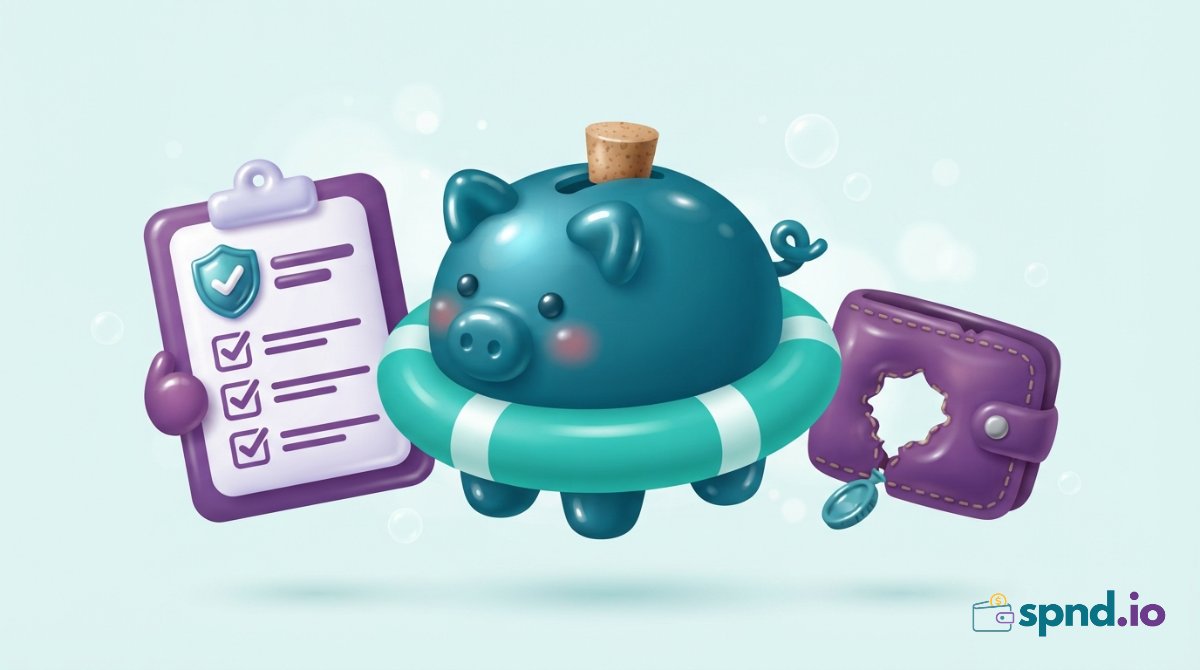
Emergency fund piggy bank with a lifebuoy ring beside a coverage checklist and a torn wallet

Why this connects directly to your emergency fund

Your emergency fund is built to cover months, not years. A long-term disability that keeps you out of work for an extended stretch will exhaust even a well-built emergency fund eventually -- disability insurance is what covers the gap your emergency fund was never designed to cover on its own. They're solving different timeframes of the same underlying risk.

What to actually check

  • Do you have any disability coverage through work right now, and what percentage of income does it actually replace?
  • How long does employer coverage last, and what happens to your income after that point?
  • If you're self-employed or a contractor, do you have any coverage at all?

This is exactly the kind of coverage gap a qualified insurance professional can map out properly for your specific income and situation -- connect with one here if you're not sure where your current coverage actually stands.

Share this article: 𝕏 Twitter Facebook
J
Jonathon Hyjek
Founder & CEO, spnd.io

I've spent 20+ years in the trenches of personal finance — running businesses, surviving debt, and learning what it actually takes to build wealth. spnd.io is built from real-world experience, not textbooks.

Related Articles