The 'latte factor' has become a cliché in personal finance — usually argued about by people who drink coffee and people who think drinking coffee is a moral failure. Both groups are missing the point.
The point is not whether you should buy coffee. The point is what the math actually looks like over a decade or three, so you can make an honest decision instead of a reflexive one. This breakdown uses real 2026 prices in the US and Canada, shows you the compounding investment math, and leaves the lifestyle choice where it belongs: with you.
What Coffee Actually Costs in 2026
Prices vary by city, but the typical 2026 coffee spend falls into four tiers.
The four tiers
-
Tier 1 — Drip coffee, basic chain ($3.50-$4.25 US / $3.75-$4.50 CAD): Dunkin' small, Tim Hortons medium, McDonald's medium.
-
Tier 2 — Specialty chain drink ($5.50-$7.00 US / $6.00-$7.50 CAD): Starbucks latte, Blue Bottle, Second Cup specialty.
-
Tier 3 — Premium / seasonal ($7.00-$9.00 US / $7.50-$9.50 CAD): Pumpkin Spice, Oatmilk-anything, Nitro cold brew, venti sizes with extras.
-
Tier 4 — Third-wave / craft ($6.00-$12.00 US / $6.50-$13.00 CAD): Independent cafes, single-origin pour-overs, espresso tonics.
Most coffee drinkers land at tier 2 or mix tier 1 and tier 2, averaging about $5 per drink. That is the number this article uses as the baseline.
The Daily, Monthly, and Yearly Math
A $5 coffee, bought every workday (roughly 250 days a year accounting for weekends and time off):
-
Daily: $5
-
Weekly (5 workdays): $25
-
Monthly (average): ~$108
-
Yearly (workdays only): $1,250
But most coffee drinkers do not stop on weekends. If you average 7 days a week:
-
Daily: $5
-
Weekly: $35
-
Monthly: ~$152
-
Yearly: $1,825
Over a 40-year working career, that is $73,000 in cash spent — assuming coffee prices stay the same, which they will not. Adjusted for historical coffee inflation of about 4% per year, the real total is closer to $115,000.
The Investment Alternative
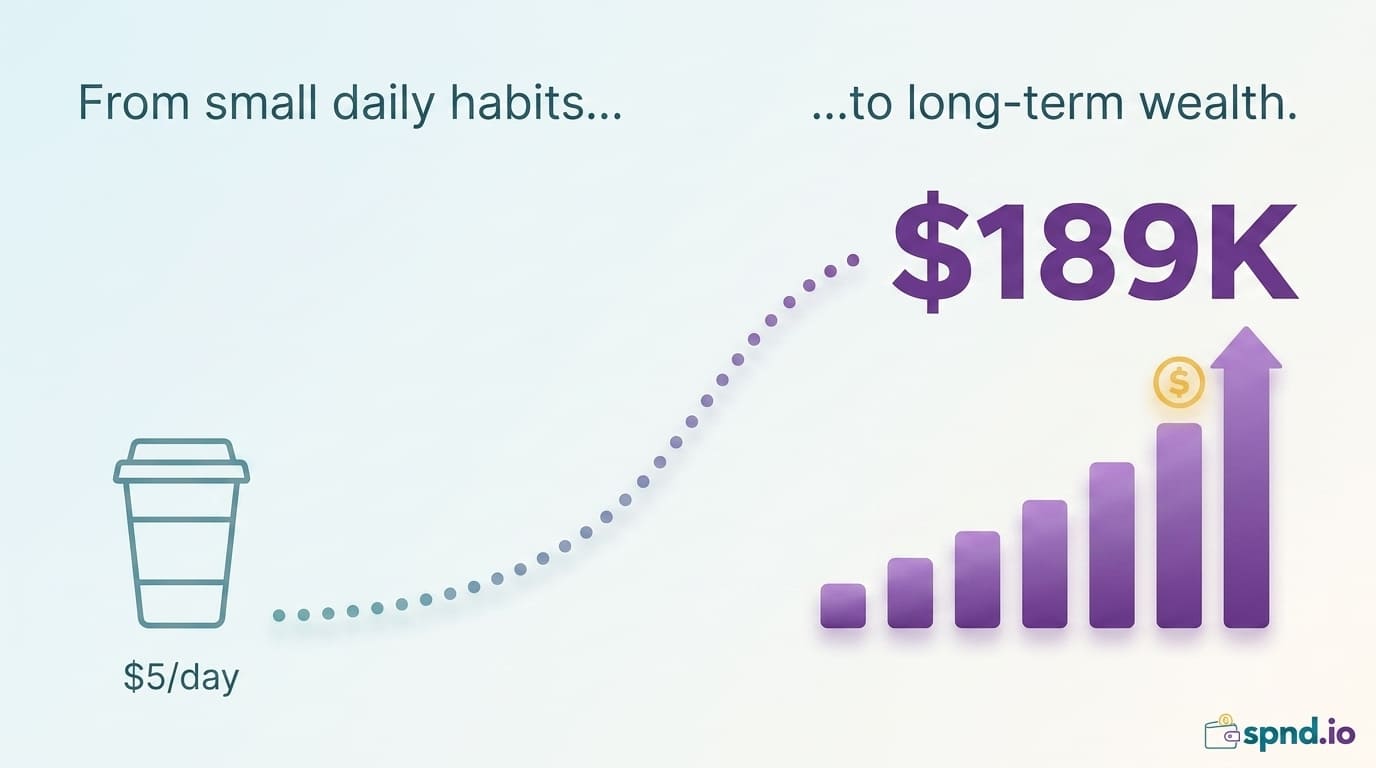
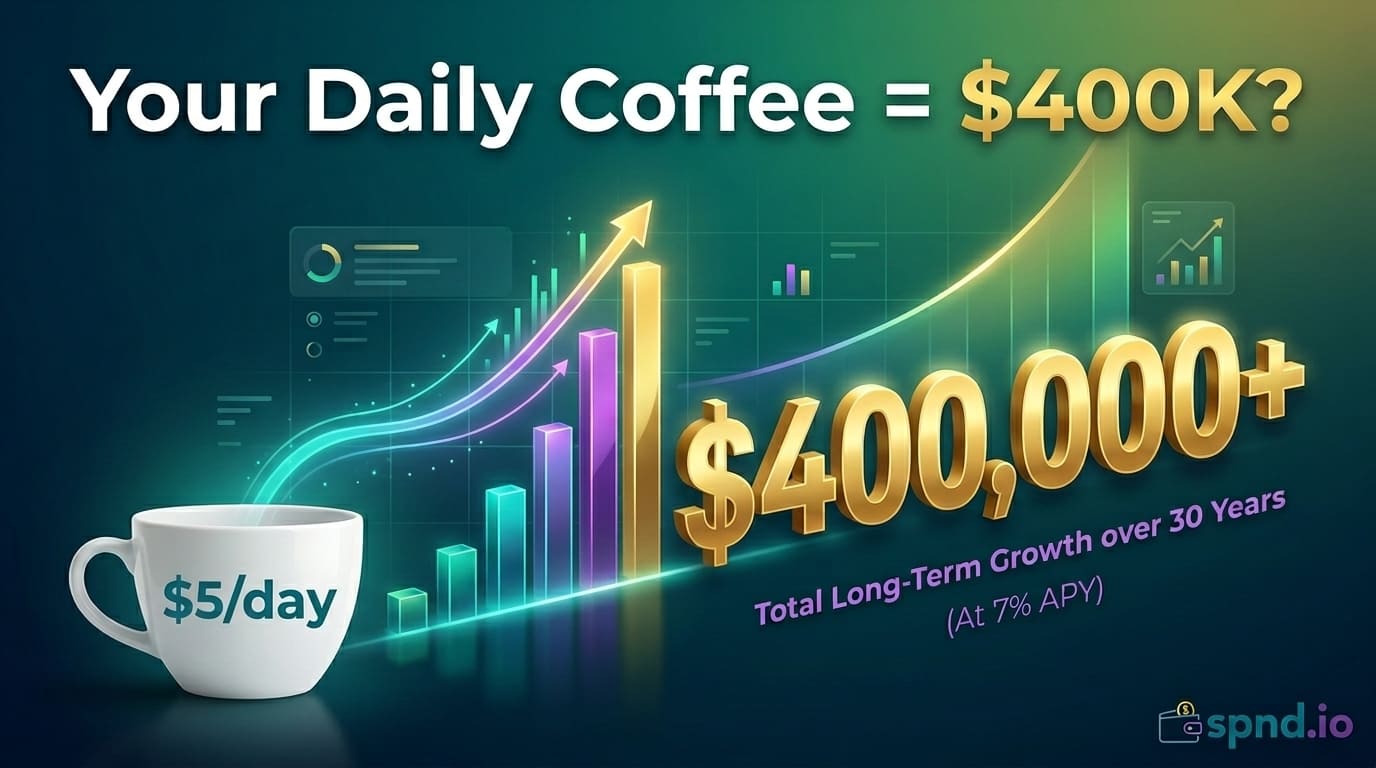
Featured Snippet Target: If you invested $5 per day at a 7% average annual return (the historical long-term S&P 500 average adjusted for inflation), you would have approximately $26,400 after 10 years, $79,000 after 20 years, $189,000 after 30 years, and $405,000 after 40 years.
Here is the side-by-side comparison of cash spent vs invested at 7% annual return:
10 years
-
Total spent on coffee: $18,250
-
Same money invested: $26,400
-
Opportunity cost: $8,150 in forgone growth
20 years
-
Total spent on coffee: $36,500
-
Same money invested: $79,000
-
Opportunity cost: $42,500
30 years
-
Total spent on coffee: $54,750
-
Same money invested: $189,000
-
Opportunity cost: $134,250
40 years
-
Total spent on coffee: $73,000
-
Same money invested: $405,000
-
Opportunity cost: $332,000
The 40-year number is not a trick. That is just compound interest doing its job — at 7%, money doubles roughly every 10 years, and the last decade of compounding is bigger than the first three decades combined.
What If You Drink Premium Coffee?
Same math at $7 per day (a venti specialty drink):
-
Yearly cash spent: $2,555
-
10-year cash spent: $25,550
-
Invested at 7% over 30 years: $264,000
Same math at $9 per day (daily premium + a snack):
-
Yearly cash spent: $3,285
-
10-year cash spent: $32,850
-
Invested at 7% over 30 years: $340,000
Making Coffee at Home: The Actual Savings
Before anyone wags a finger, making coffee at home is not free — but it is not close to the bought-out price either.
Home coffee math
-
Good coffee beans: $12-20 per pound, yields ~40 cups ($0.30-0.50 per cup)
-
Milk, cream, or oat milk: ~$0.20-0.40 per cup with add-ins
-
One-time equipment cost (reasonable setup): $50-200, spread over years
-
All-in cost per cup: $0.50-1.00
Replacing a $5 café drink with a $0.75 home coffee saves $4.25 per day. Seven days a week, that is $1,550 per year. Invested at 7% for 30 years: about $160,000.
The Middle Ground Nobody Tells You About
The usual coffee argument is binary: drink it and accept the cost, or never drink it and save the money. Neither is a plan that survives real life.
The middle ground that actually works for most people:
-
Make coffee at home on workdays (saving $4-5 per day).
-
Buy coffee out on weekends or 2-3 times per week as a deliberate treat (social, ritual, creative break).
-
Automatically invest the difference — around $100 per month — into a retirement account or brokerage fund.
This keeps the ritual that actually matters to you, removes the daily autopilot spending, and redirects about $36,000 over 30 years into real wealth. You do not have to become a coffee monk.
Why This Is Not About Coffee
Coffee is just the most visible daily habit. The same math applies to:
-
Lunch out at $15/workday instead of $5 homemade: ~$2,500/year opportunity cost
-
Vending machine snacks at $3/workday: ~$750/year
-
Streaming services you forgot you had: ~$400-600/year
-
Ride-share when transit or walking was an option: ~$1,500-3,000/year in urban areas
The point is not to cut any one specific thing. The point is that 'small' daily expenses are lying about their size because your brain is bad at compound interest. $5 a day sounds trivial. $189,000 does not.
How to Decide What Is Worth It
Not every habit should be cut. Some are worth the money — just not all of them are.
A test that separates worth-it from waste:
-
If you stopped buying it for 30 days, would you even notice? (If no → cut it.)
-
Does the habit actively improve your mood, energy, or health? (If yes → keep it intentional.)
-
Is it social or relational? (If yes → usually worth preserving.)
-
Does it happen on autopilot without any enjoyment? (If yes → cut without guilt.)
For most people, that means keeping 2-3 intentional 'treats' per week and killing the autopilot habits that do not actually make life better. The combined savings from killing autopilot habits — coffee, lunch, snacks, ride-share, subscriptions — typically adds up to $3,000-6,000 per year with zero quality-of-life impact.
Run the Numbers for Your Own Habit
The numbers in this article use $5 as an example. Your actual habit might cost more, or less, or be something completely different. The compounding math works the same regardless.
Plug your real daily habit into a daily habit calculator to see your specific 10-year, 20-year, and 30-year numbers. Do not cut anything based on an article — cut it based on your own numbers and your own judgment about whether the thing is actually worth its price.
Use the free Daily Habit Calculator on spnd.io to plug in your own habit — coffee, lunch, subscriptions, anything. See the 10-year cash cost and the 10-year opportunity cost side by side, and decide for yourself what is worth keeping.