Explore
Categories
More Categories
Money 101Learn the fundamentals of personal finance
DebtCredit card payoff & multi-debt strategy
Taxes & IncomeTake-home pay & self-employment tax
All Financial CalculatorsBrowse our complete suite of free money tools
Mortgage & HousingAffordability, buy vs rent, mortgage payments
Budgeting & CashflowBudget, cashflow & emergency fund planning
BlogPractical money tips and strategies
RetirementRetirement savings & RRSP/401(k) planning
Investing & Net WorthTrack your total financial picture
No-Fee BanksCompare fee-free bank accounts
InsuranceLife insurance coverage planning
Everyday ToolsCurrency exchange & daily habit cost
For ProfessionalsBuy pre-qualified leads in your area
Habits

10 Daily Habits That Are Costing You Thousands

J
Jonathon Hyjek
Last Updated: November 18, 2026 · 3 min read
10 Daily Habits That Are Costing You Thousands
TL;DR

Discover how small daily expenses add up over time and strategies to redirect that money toward wealth building.

We all have habits — some good, some bad — but what if the little things you do every day are quietly draining your bank account? Over time, small expenses can snowball into thousands of dollars lost. Here are 10 common daily habits that might be costing you more than you realize, along with fixes to break free and save big.

1. Buying Coffee on the Go

You're late, you're rushed, so you grab a latte. But if you're grabbing one every weekday, that's $5 a drink, or $7 a year. Over a decade, you're looking at $13,000 — enough for a car or a long, dream vacation. Use our Daily Habit Calculator to see exactly what your coffee habit is costing you. Fix it: brew your own coffee at home. A one-time coffee maker and beans barely dent your bank account, and you'll save thousands long term.

2. Eating Out for Lunch

Grabbing takeout or hitting a restaurant for lunch can easily cost $10–$15 a day. Do that five days a week, and you're spending $50–$75 weekly, or $3,000 annually. Over ten years? That's nearly $35,000. Fix: Meal prep instead. A homemade lunch costs $3–$5, cutting your yearly expense to under $1,000.

3. Subscription Overload

Netflix, Spotify, gym memberships, that meditation app you forgot about — subscriptions add up. If you're spending $10 on each of ten services, that's $100 a month, or $48,000 per decade. Fix: Audit your subscriptions monthly. Cancel anything you don't use regularly and ditch the redundant ones.
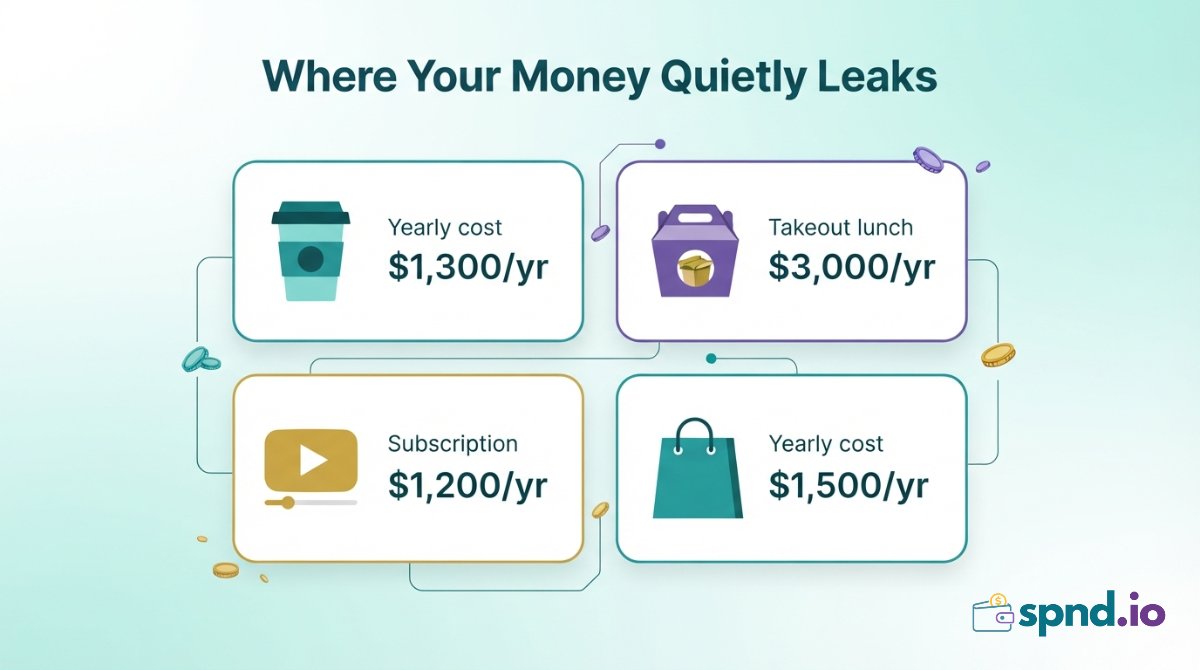
Grid of daily habits and their yearly cost: coffee $1,300, takeout lunch $3,000, subscriptions $1,200, online shopping $1,500

4. Impulse Online Shopping

A 10-minute scroll, a $25 gadget there — daily impulse buys fuelled by ads or boredom can reach $1,500 a year. That's $15,000 over a decade. Fix: Add a 24-hour delay if you still want it tomorrow, then consider buying. Most regret fades by then.

5. Driving Everywhere

If you drive short distances instead of walking or biking, you're burning gas and racking up wear and tear costs. Gas and maintenance can cost you an extra $1,500 a year — that's $15,000 at most, or $150,000 in a decade. Fix: Walk or bike for trips under a mile where possible. You'll save money and get some exercise too.

Enjoying this? Get more like it.

Weekly tips and tools to build wealth, straight to your inbox. Free, no spam.

By subscribing, you agree to our terms and privacy policy.

6. Bottled Water Addiction

Buying a $2 bottle of water daily adds up to $730 a year, or $7,300 over 10 years. Multiply that if your whole family does. Fix: Invest in a reusable water bottle and a filter for your tap. Your wallet and the planet will thank you.

7. Ignoring Energy Waste

Leaving lights on, cranking the AC, or leaving devices plugged in can inflate your utility bills by $10–$20 a month. That's $120–$2,400 a year, or $1,200–$24,000 total annually. Fix: Unplug electronics, use LED bulbs, and adjust your thermostat. Small tweaks, big savings.

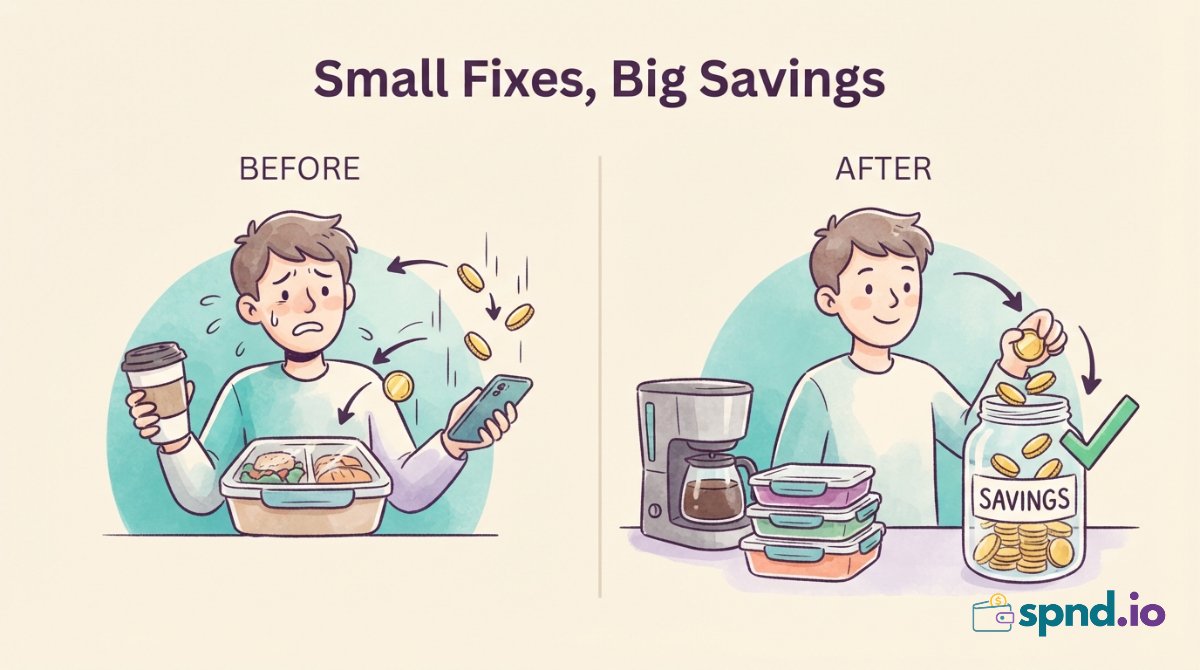
Before and after illustration of swapping takeout coffee and lunch for home brewing and meal prep to save money

8. Smoking or Vaping

A pack or cigarettes or vape juice can cost $8–$10 a day. At $10 daily, that's $3,500 a year — $35,000+ over 10 years. And that's before healthcare costs kick in. Fix: Quitting is tough, but worthwhile. Look into free cessation programs or apps to help you kick the habit.

9. Paying Full Price for Everything

If you're not hunting for discounts, using coupon apps, or timing purchases, you're overpaying daily. Shaving just 10–20% savings on a $50 weekly grocery bill cuts you $500–$1,000 a year, or $10,000 in a decade. Fix: Use apps like Flipp or Ibotta, buy in bulk, and shop when items are on sale. A little planning goes a long way.

10. Late Fees and Interest

Forgetting to pay bills or carrying a credit card balance can cost $50 a month in late fees and interest — that's $600–$6,000 a year, or $6,000–$60,000 over 10 years in worst case scenarios. Fix: Set up autopay for any bills and pay off your credit card in full each month. Avoid the debt trap entirely.

The Bottom Line

These habits might seem harmless in the moment, but the math doesn't lie — they're costing you thousands over time. Start by addressing one or two to make the transition manageable. The ones that actually matter to your bottom line? Fix those first. You'll be thankful you did today, and watch the savings stack up. Your future self will thank you.

Share this article: 𝕏 Twitter Facebook
J
Jonathon Hyjek
Founder & CEO, spnd.io

I've spent 20+ years in the trenches of personal finance — running businesses, surviving debt, and learning what it actually takes to build wealth. spnd.io is built from real-world experience, not textbooks.

Related Articles