Most advice about cutting daily habits stops at the cutting. 'Stop buying coffee and save $1,800 a year.' Great — and then most people do not save $1,800 a year. They just stop buying coffee, and the $5 a day gets quietly absorbed into their regular spending within two months, like a stream disappearing into sand.
The habit-to-wealth conversion only happens when you build the bridge between the thing you cut and the place the money goes. This post walks you through exactly that bridge, step by step, including which accounts to use, how much automation to set up, and how to keep it running without willpower for the next 30 years.
The Math, Briefly
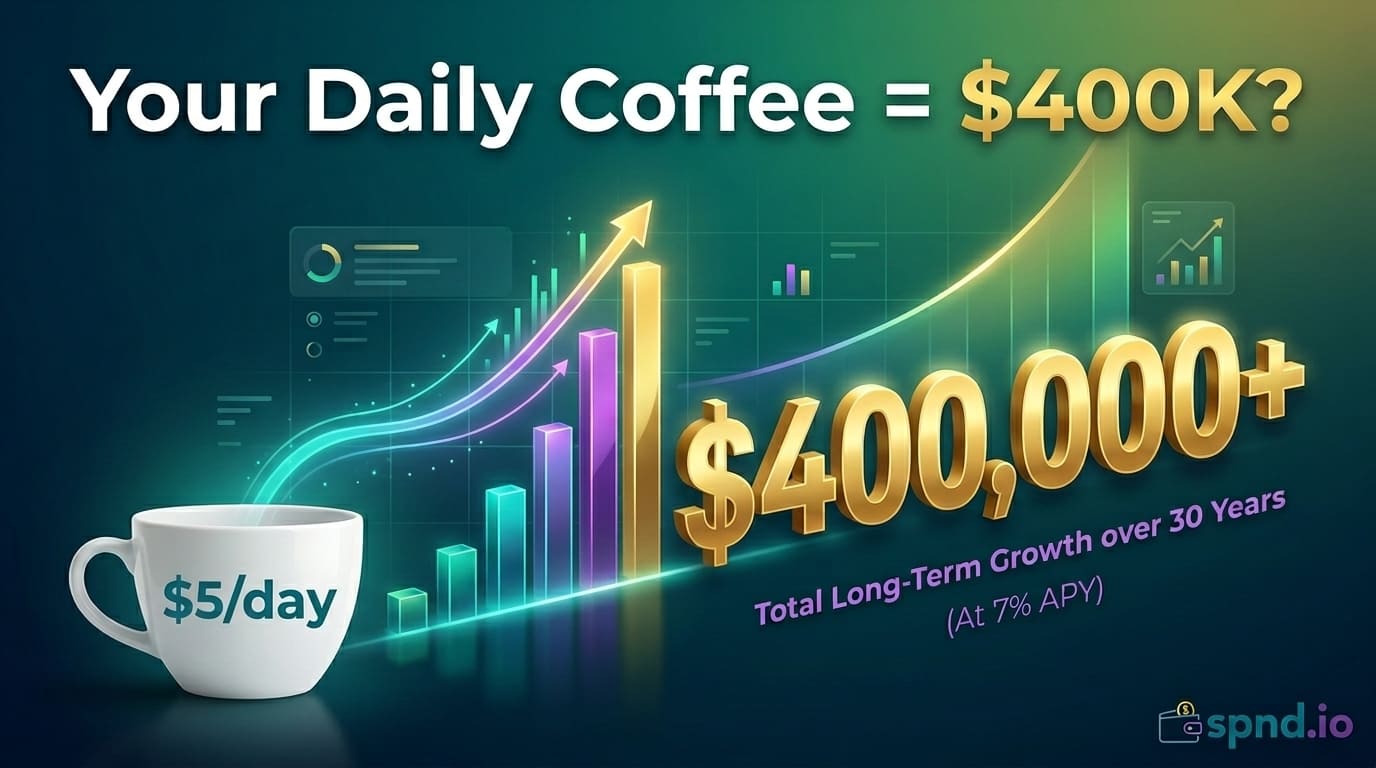
Invested at a 7% average annual return (the historical long-term average of the US stock market adjusted for inflation), $5 per day grows to:
-
5 years: $10,900
-
10 years: $26,400
-
15 years: $48,400
-
20 years: $79,000
-
25 years: $123,000
-
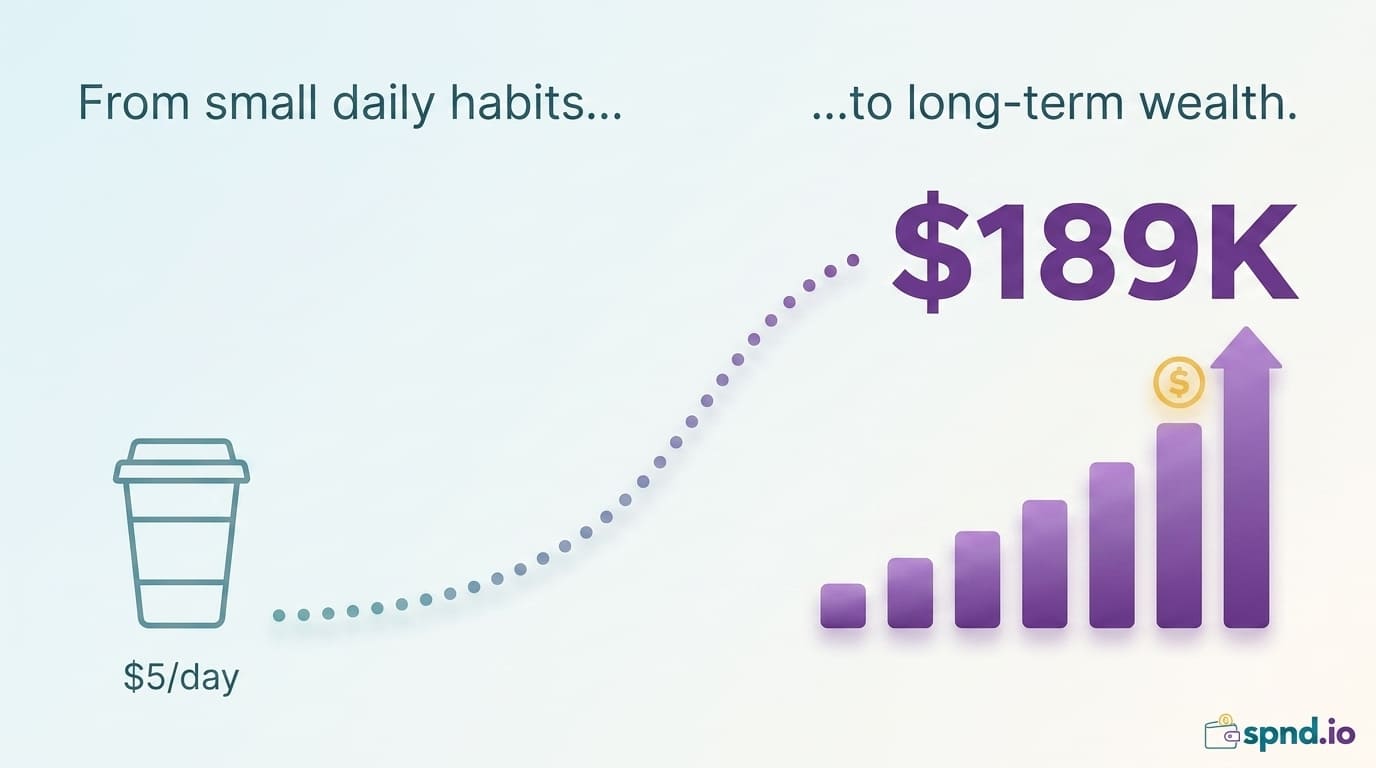
30 years: $189,000
The same numbers at $10/day: $378,000 over 30 years. At $20/day: $756,000. The dollar amount matters less than the consistency and time.
Why This Fails for Most People
The math is not the hard part. The hard part is the three failure points that kill 90% of redirect-to-wealth attempts.
Failure 1 — The money never moves
You cut the coffee. The $5/day stays in your checking account. It gets spent on something else within a week. You did not become wealthier, you became a person who drinks less coffee. The cut has to trigger a transfer or nothing changes.
Failure 2 — Manual transfers fall apart
'I'll move the money every Friday' works for about six weeks. Then you forget. Then you remember but you are busy. Then the month ends. Then two months end. Manual habits die; automation does not.
Failure 3 — The money sits in cash
You set up the transfer, the money moves, and it sits in a savings account earning 0.5%. Over 30 years, $5/day at 0.5% becomes about $59,000. At 7%, it becomes $189,000. The $130,000 difference is purely because the money was invested instead of parked. The redirect only builds real wealth when it ends up in something that actually grows.
The Four-Step Bridge
Step 1: Pick the habit
One habit. Not five. The 'I'll cut everything' plan always collapses. Pick the single most wasteful autopilot habit you have — usually something like a daily takeout lunch, premium coffee, ride-share when transit works, or forgotten subscriptions. Calculate the monthly dollar value. This is your transfer amount.
Example: You cut a $7 daily specialty coffee habit. Monthly savings: ~$210. Round down to $200/month for easy math.
Step 2: Open the right account
For most people starting out, the right order is:
-
If you have credit card debt above 7%, the 'investment' is paying that down — higher guaranteed return than any stock.
-
If you have no emergency fund, put the first $1,000-$5,000 in a high-yield savings account.
-
Once you have the starter emergency fund, open a retirement account. In the US: a Roth IRA if you qualify. In Canada: a TFSA. Both grow tax-free.
-
If those are already funded, a taxable brokerage account works for additional investing.
You do not need a financial advisor for this. Any major brokerage (Fidelity, Schwab, Vanguard in the US; Wealthsimple, Questrade, TD Direct in Canada) opens the account online in about 20 minutes.
Step 3: Automate the transfer
Set up an automatic monthly transfer from your checking account into the investment account, dated 1-2 days after your paycheck lands. This is non-negotiable. Do not 'manually transfer when I remember.' Do not 'transfer when I feel good about my finances.' Automation is the entire difference between the people who succeed and the people who do not.
Most brokerages also let you automate the investment itself — so when the $200 lands in the account, it automatically buys whatever fund you have selected. Turn this on. The less you have to log in and click, the longer it lasts.
Step 4: Pick the investment (once)
For 95% of people, this step is simpler than the internet makes it sound. You want one of two things:
-
A target-date fund matching your retirement year (ex: 'Vanguard Target 2060'). It auto-balances over time. Pick it and forget it.
-
A broad market index fund (S&P 500 or total-market). Slightly more DIY but slightly lower fees.
Do not overthink this. The difference between 'good enough' and 'perfect' investing is probably 0.2% per year. The difference between investing and not investing is 7% per year. Get invested first, optimize later.
Why $5 Works (And So Does $50)
People dismiss small amounts because they sound trivial. A few reasons they are not.
Consistency beats size
$5/day for 30 years outperforms $150/month for 15 years, even though they are the same amount contributed. The extra 15 years of compounding make the smaller daily contribution grow to $189,000 vs ~$47,000. Time in the market beats timing the market and beats size of contribution.
Small amounts feel safer to start
A $500/month savings target feels impossible for most people, so they never start. A $5/day redirect feels manageable, so people actually do it. The habit of investing is worth more in year one than the size of the contribution — because once the habit is built, you naturally ramp it up.
$5 is a ceiling only if you keep it there
Start with $5/day. Next year, when you get a raise or you notice a second wasteful habit, add $3/day. The year after, $2 more. Within 5-7 years most people naturally grow the automatic savings to $15-25/day with no pain, because the lifestyle adjusted around the smaller number.
What to Do If You Slip
The biggest threat to the 30-year plan is not market crashes — it is the day you look at your budget and think 'I cannot afford the $200 transfer this month' and pause it. Once paused, many people never resume.
The rule that protects you:
-
If you genuinely cannot afford it, reduce the amount — do not pause it. $50 still landing in the account beats $0. Do not break the automation streak.
-
If the real problem is a one-time expense, let the checking account go into overdraft protection for a day. Do not stop the transfer.
-
If something long-term has changed (job loss, new baby, big move), adjust the amount once — then leave it alone for a year before adjusting again.
Compounding in Plain English
The reason this works when so few people experience it is that the early years feel tiny and the late years feel enormous, and almost everyone quits during the tiny years.
-
Year 1: You contributed $1,825. The account has ~$1,900. Gain: $75. Unimpressive.
-
Year 5: You have contributed $9,125. Account: ~$10,900. Gain: $1,775.
-
Year 10: Contributed $18,250. Account: $26,400. Gain: $8,150. Now it is working.
-
Year 20: Contributed $36,500. Account: $79,000. Gain: $42,500 above contributions.
-
Year 30: Contributed $54,750. Account: $189,000. Gain: $134,250 above contributions.
Most of the money — the difference between $54,750 contributed and $189,000 final — is not your money at all. It is compound interest working on itself, on top of itself. The only way to access that effect is to start early and not stop.
The Only Habit That Matters
You do not need to optimize. You do not need to pick perfect funds. You do not need to read 10 more personal finance articles. You need to pick one habit worth cutting, open one investment account, set up one automatic transfer, pick one fund, and not touch it.
If you did that this week with $5/day, 30 years from now you would have an extra $189,000. If you wait six months to start it, you give up about $5,000 of that future money. If you wait two years, you give up $22,000. Starting small today beats starting big 'later' every single time.
Start by seeing your actual habit cost — then the real 30-year number. The free Daily Habit Calculator on spnd.io shows both. Once you know your number, the hardest part (deciding) is done.