Explore
Categories
More Categories
Money 101Learn the fundamentals of personal finance
DebtCredit card payoff & multi-debt strategy
Taxes & IncomeTake-home pay & self-employment tax
All Financial CalculatorsBrowse our complete suite of free money tools
Mortgage & HousingAffordability, buy vs rent, mortgage payments
Budgeting & CashflowBudget, cashflow & emergency fund planning
BlogPractical money tips and strategies
RetirementRetirement savings & RRSP/401(k) planning
Investing & Net WorthTrack your total financial picture
No-Fee BanksCompare fee-free bank accounts
InsuranceLife insurance coverage planning
Everyday ToolsCurrency exchange & daily habit cost
For ProfessionalsBuy pre-qualified leads in your area
Financial Planning

How Much House Can You Afford on a Single Income?

J
Jonathon Hyjek
Last Updated: November 19, 2026 · 4 min read
How Much House Can You Afford on a Single Income?
TL;DR

Buying on one income means less room for error, not less of a chance. Here's how the math actually changes, and what to do differently.

Buying a home on a single income isn't a smaller version of buying on two incomes — it's a genuinely different financial situation, with less margin for error but not necessarily a smaller realistic budget than people assume. The math is the same formula lenders always use, but every input matters more when there's only one paycheque behind it.

The Core Math Doesn't Change

Lenders still look at your debt-to-income ratio the same way regardless of how many incomes are behind the application: your housing costs plus other debt payments, measured against your gross income. What changes is the stakes — on a dual income, if one person loses a job, the other paycheque still covers the baseline. On a single income, that same job loss means the mortgage payment has no backup at all.
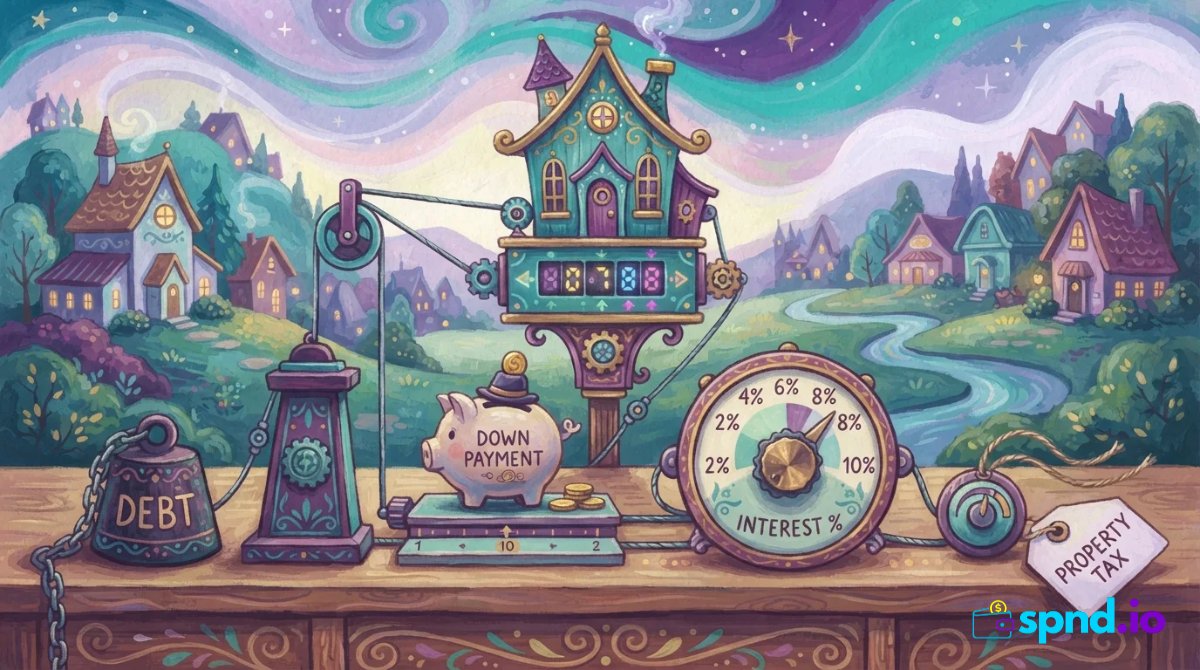
Steampunk-style dials and sliders controlling a house price: debt weight, down payment piggy bank, interest dial and property tax tag

What Actually Changes Your Numbers

  • Your down payment matters more. A larger down payment lowers your monthly payment and your risk exposure at the same time — on a single income, that double benefit is worth prioritizing over buying sooner with less down.
  • Your emergency fund needs to be bigger. Most advice suggests 3-6 months of expenses; single-income homeowners are often better served by 6-9 months, specifically because there's no second income to lean on during a gap.
  • Fixed-rate security matters more. A variable rate that could rise is a bigger risk when there's only one income absorbing the increase.
  • Other debt matters more. Carrying a car loan or credit card debt eats into how much mortgage you can responsibly take on faster on a single income, since there's no second income to offset it.


Person carrying a small bag of savings along stepping stones from an apartment to a modest house

Enjoying this? Get more like it.

Weekly tips and tools to build wealth, straight to your inbox. Free, no spam.

By subscribing, you agree to our terms and privacy policy.

A Realistic Approach

Rather than stretching to the maximum a lender will approve, many single-income buyers are better served by deliberately buying below their approved limit — leaving genuine breathing room for the unexpected, rather than running at full capacity from day one. This isn't about buying less house out of fear; it's about building in the margin that a second income would otherwise provide automatically.

Run your actual numbers with our Home Affordability Calculator to see what you can responsibly carry on your specific income, debts, and down payment — and don't just take the maximum number it gives you as your target. Once you have a realistic price range, our Mortgage Calculator shows exactly what the monthly payment looks like, including how extra payments could shorten the loan if your income allows it later.

If you want a second opinion on what's actually sustainable for your specific situation, not just what you're approved for, a mortgage broker can walk through the numbers with you directly.

Share this article: 𝕏 Twitter Facebook
J
Jonathon Hyjek
Founder & CEO, spnd.io

I've spent 20+ years in the trenches of personal finance — running businesses, surviving debt, and learning what it actually takes to build wealth. spnd.io is built from real-world experience, not textbooks.

Related Articles