The 'save 3-6 months of expenses' rule has been the default emergency fund advice for decades. It is not wrong, but it has not aged well — it treats a dual-income tech worker and a single-parent gig worker identically, and they need very different buffers.
This guide walks through a modern framework for figuring out your right number. It covers what counts as 'emergency expenses,' how to factor in your specific income stability, where to keep the money, and how to actually build the fund if starting from zero.
What an Emergency Fund Actually Protects Against
An emergency fund exists for expenses that are (a) unexpected, (b) necessary, and (c) would otherwise force you into debt. Three classic triggers:
-
Job loss or major income disruption
-
Major medical expense or accident
-
Unexpected essential repair (car breaks down, furnace fails, roof leaks)
What does not count as an emergency: holiday gifts, vacation costs, annual insurance renewals, birthday gifts, wedding gifts. These are predictable expenses and belong in sinking funds (dedicated savings for specific anticipated costs), not your emergency fund.
Calculate Your Essential Monthly Expenses
The right fund size is a multiple of essential monthly expenses — not total monthly spending. Essential expenses are the bills you absolutely cannot skip, even in a tight month:
-
Housing (rent or mortgage, property tax, insurance)
-
Utilities (electric, water, heat, basic internet, basic phone)
-
Groceries (essentials only, not dining out)
-
Transportation (car payment, insurance, fuel for essential trips, or transit pass)
-
Minimum debt payments
-
Essential insurance premiums (health, auto)
-
Childcare if required
Strip out: dining out, streaming, gym memberships, hobbies, travel, gifts, shopping, upgrades. If an emergency hits, these are the first things you would cut. Your emergency fund does not need to cover them.
Quick math: If your total monthly spending is $5,000 and about $3,400 of that is essential, your baseline is $3,400 — not $5,000. This alone can reduce your target fund size by 25-35%.
The Modern Fund-Size Framework
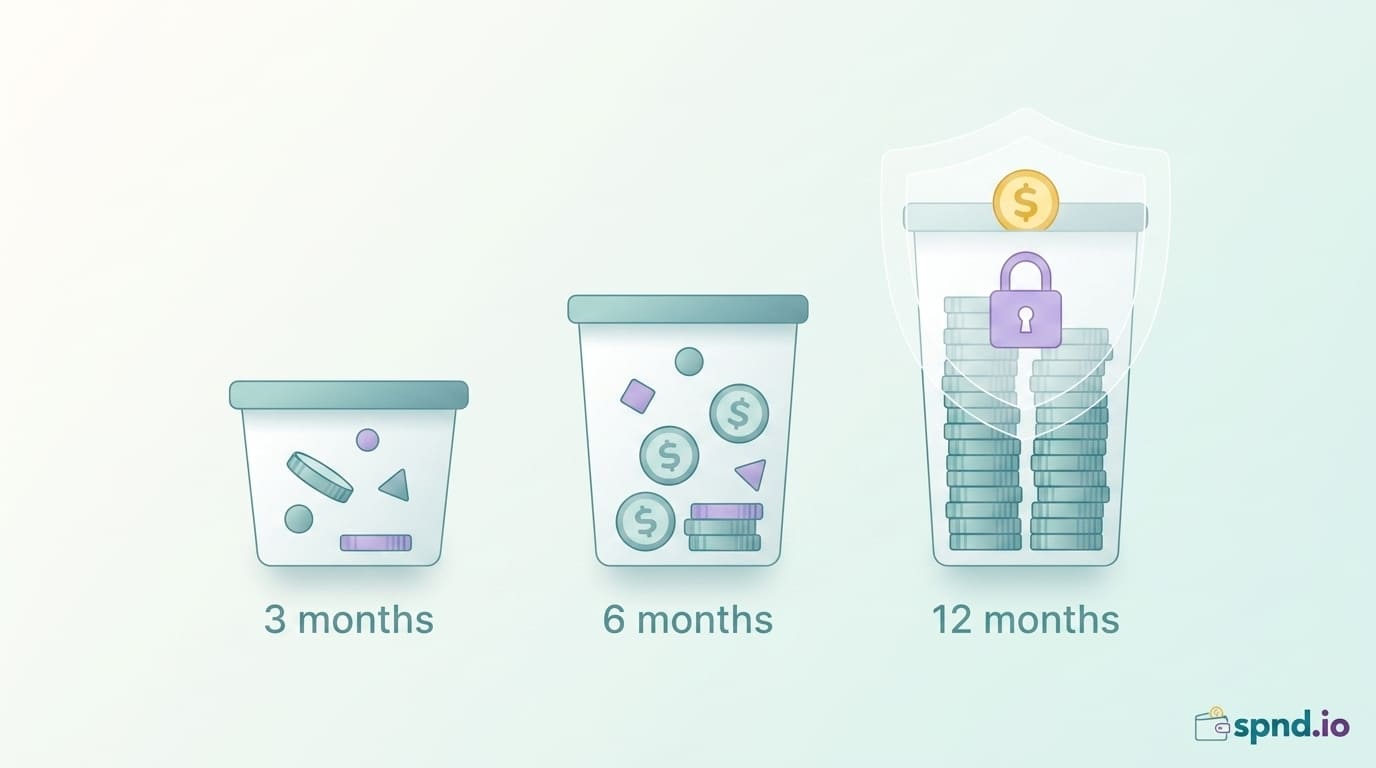
3 Months of Essential Expenses
Right for:
-
Dual-income households where both earners work in stable industries
-
Government or tenured employees
-
Highly employable professionals in high-demand fields (healthcare, skilled trades, certain tech)
-
No dependents, low fixed costs
The logic: if one income disappears, the other carries the household while a replacement job is found, which statistically takes 8-12 weeks for employable professionals.
6 Months of Essential Expenses
Right for:
-
Single-income households
-
Average job stability with typical industry risk
-
One dependent, mortgage, standard family situation
-
People whose specialized skills might take longer to find a match
This is the classic 'standard recommendation' for a reason — it covers the most common life situations.
9-12 Months of Essential Expenses
Right for:
-
Self-employed, freelance, or gig workers
-
Commission-heavy roles (sales, real estate)
-
Single-income household with multiple dependents
-
People in industries with long hiring cycles (academia, senior management, niche specialties)
-
Recent health concerns or pre-existing conditions that could affect work capacity
-
People approaching retirement (55+) since re-entry to the workforce gets harder
Beyond 12 Months
Generally excessive. Money held in an emergency fund earns low returns compared to investing. Once you pass 12 months of essentials, additional money should usually go into retirement accounts, investments, or debt payoff — not more cash. Exceptions: startup founders without a salary, people with highly variable income (entertainment, professional athletes), or anyone with a specific known large expense on the horizon.
The Two-Tier Approach
A useful refinement: split your emergency fund into two tiers.
Tier 1 — Immediately accessible ($1,000-$5,000)
In a high-yield savings account at a no-fee online bank. This covers small emergencies — car repair, small medical bill, sudden travel for a family emergency — without forcing you to touch investment accounts or dip into credit.
Tier 2 — Secondary reserve (remainder)
Also in a high-yield savings account, but fine to separate from the first tier mentally. This is the multi-month reserve for job loss or major disruption. You touch it only if the disruption is real and extended.
Some people hold tier 2 in slightly less liquid but higher-yielding vehicles (I Bonds, short-term CDs). This is fine once you have tier 1 solidly funded, though the return improvement is modest relative to the complexity added.
Where to Keep Your Emergency Fund
The emergency fund is the one account where the rule is 'accessible and safe, not optimized for return.' Rules of thumb:
-
Use a high-yield savings account — typically 3-5% APY at major online banks in 2026
-
Use a no-fee account so fees are not eating your returns
-
Keep it at a different bank than your primary checking — helps reduce the 'accidental spending' problem
-
Make sure it is federally insured (FDIC in US, CDIC in Canada)
-
Avoid stocks, crypto, or anything volatile — emergencies often coincide with market downturns (job losses spike in recessions, which also crash portfolios)
Do not chase yields. The difference between a 4% and 5% savings account on a $20,000 fund is $200/year. The difference between having the fund and not having it is your entire financial stability.
How to Build It From Zero
If you have no emergency fund right now, here is the priority order financial planners generally agree on:
-
Build a $1,000-$2,000 starter fund as quickly as possible. Stop other financial goals (except employer 401(k) match) until this is funded. Aim for 30-60 days.
-
Pay off high-interest debt (credit cards above 15-20%). Paying off a 22% credit card is a guaranteed 22% return — better than any investment.
-
Build emergency fund to 3 months of essential expenses.
-
Start retirement contributions to capture full employer match.
-
Build emergency fund up to your target size (6, 9, or 12 months based on your situation).
-
Increase retirement contributions toward the 15% of income target.
The specific sequence matters less than the specific habit: automated transfers on payday. Pick an amount — even $50/week — and set up a recurring transfer to your emergency fund account. Do not rely on 'I will save what is left at the end of the month,' because there will never be any left at the end of the month.
When to Use It (And When Not To)
Use it for
-
Loss of employment or major income disruption
-
Major medical bills beyond what insurance covers
-
Essential home repairs you cannot delay (roof, HVAC, major plumbing)
-
Car repairs needed to get to work
-
Emergency travel for family matters
Do not use it for
-
Holiday shopping
-
Vacations
-
Non-urgent home upgrades
-
'Great deals' on things you did not plan to buy
-
Investment opportunities
-
Weddings you could have saved for separately
If you find yourself using the emergency fund for non-emergencies, the fund is not the problem. Your regular budget is the problem, and you need sinking funds for predictable expenses.
Replenishing After Use
If you had to use the emergency fund, pause everything else (except retirement match) and rebuild to at least the tier-1 level ($1,000-$5,000) before resuming other goals. Then rebuild to full target size at your normal savings pace.
Emergency funds are not a one-time project. They get used, they get refilled, they continue to exist. Anyone who has kept an emergency fund for 20 years has probably used and refilled it 3-5 times. That is exactly how it is supposed to work.
The Real Point
The emergency fund is not an investment and it is not supposed to feel like one. It is the foundation that makes every other financial decision possible. Without it, a single bad month forces you to put emergencies on credit cards, and the compound interest of a single bad emergency can undo years of financial progress.
Right-size yours based on your actual situation, park it somewhere boring and accessible, and forget about it until you need it.
Your first step is knowing your essential monthly expenses. Use the free Budget Planner on spnd.io to figure out your essentials-only number, then check the No-Fee Bank Directory for the best high-yield account to park your fund.