The life insurance industry wants you to buy permanent insurance. It pays higher commissions to agents, generates more revenue for insurers, and is the product most aggressively pushed to first-time buyers. None of that makes it the right choice for the average buyer.
Term insurance is what 90% of people need. Permanent insurance is what a small percentage of people legitimately need. This guide explains the difference, compares real costs, and tells you exactly which one you should be considering and why.
The Fundamental Difference
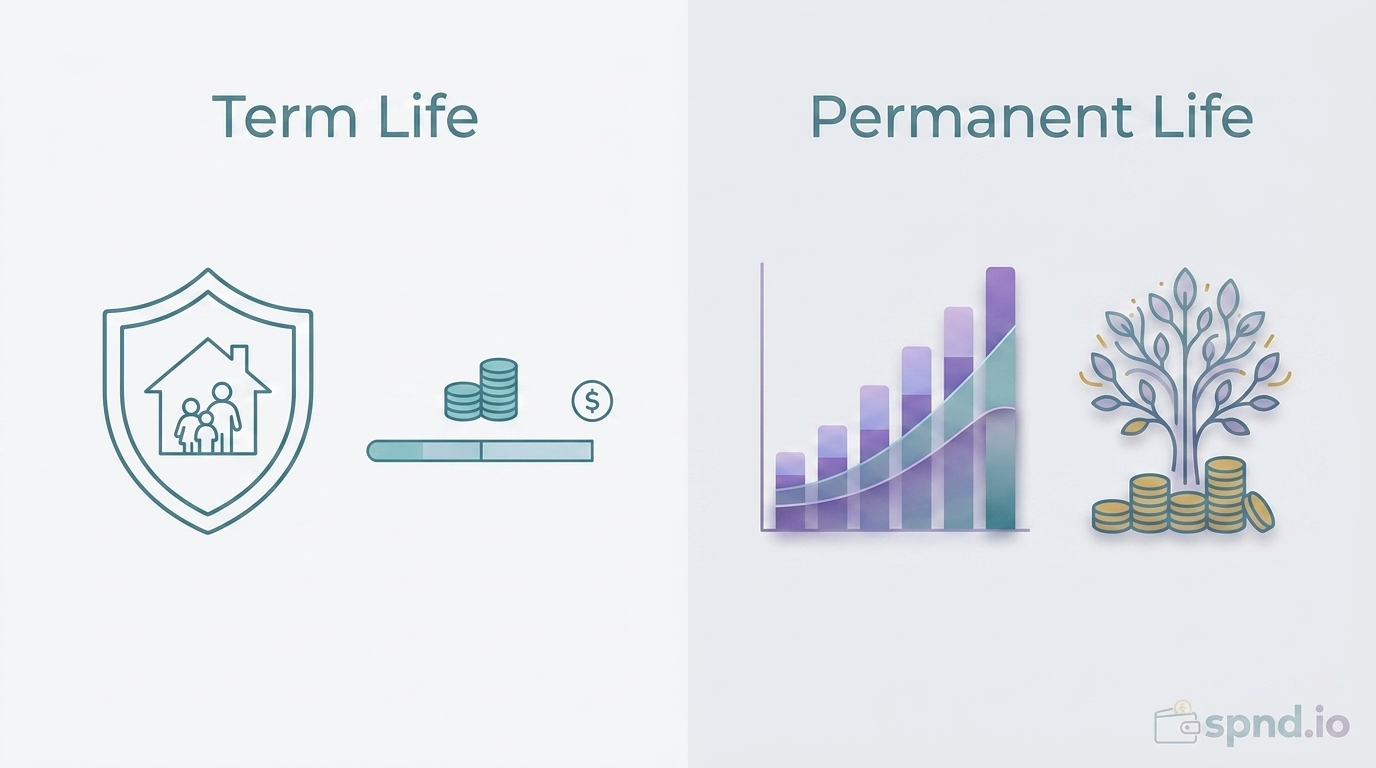
Term life insurance
Covers you for a fixed period — commonly 10, 15, 20, 25, or 30 years. If you die during that term, the policy pays out the face amount (say, $500,000) to your beneficiaries. If you outlive the term, the policy expires and there is no payout. Like car insurance — you pay for protection, and if nothing happens, the money is gone. That is the point.
Permanent life insurance
Covers you for your entire life as long as premiums are paid. Includes a 'cash value' component that grows tax-deferred over time, which you can borrow against or withdraw. Common types: whole life (fixed premiums, guaranteed cash value growth), universal life (flexible premiums, variable cash value), variable universal life (cash value invested in sub-accounts like mutual funds).
The Real Cost Comparison
A healthy 35-year-old non-smoker, $500,000 coverage, 2026 US rates:
-
20-year term: $25-35/month
-
30-year term: $40-55/month
-
Whole life: $380-520/month
-
Universal life: $275-400/month
Same person, Canadian rates are typically 10-20% higher.
The gap is not subtle. A 30-year term costs roughly one-tenth of a whole life policy for the same face amount.
The 'Buy Term and Invest the Difference' Math
The standard personal finance advice — and the math behind it — goes like this.
Using the example above: if you buy the $45/month 30-year term and invest the $450/month difference (versus whole life) in a low-cost index fund at 7% annual return:
-
After 10 years: ~$78,000 invested plus still insured
-
After 20 years: ~$233,000 invested plus still insured
-
After 30 years (term expires): ~$550,000 invested, self-insured
For comparison, the cash value of a whole life policy at year 30 for the same outlay is typically $180,000-$280,000. The buy-term-invest-the-difference strategy comes out ahead by $270,000-$370,000 over 30 years for the average buyer.
The catch: This math only works if you actually invest the difference. If you buy cheap term and spend the saved premium on lifestyle, permanent insurance — which forces the saving — may actually be better for you. Know yourself.
What Is 'Cash Value' Really?
Permanent insurance marketing leans heavily on the cash value feature. Here is what it actually is.
A portion of your premium in early years pays for the insurance cost. Another portion pays commissions and fees to the insurer. Whatever remains accumulates as cash value. In the first 5-10 years of a whole life policy, the cash value typically grows to about 50-70% of premiums paid — meaning you have given the insurance company $20,000 and have $12,000 of cash value.
Over 30+ years, cash value catches up and exceeds premiums paid. This is why the advice to 'use it as forced savings' partially works — but the returns on the cash value portion average 2-4% per year, significantly below what a basic index fund returns historically.
Accessing cash value
You can borrow against cash value at interest (paying interest to the insurance company for your own money, essentially), or you can surrender the policy for the cash value and lose the death benefit. Neither option is as clean as the sales pitch makes it sound.
When Term Makes Sense (90% of Cases)
-
You have dependents who rely on your income
-
You have a mortgage or young children
-
Your insurance need is temporary — it will end when kids are grown and assets are built
-
You want maximum coverage for minimum premium
-
You have the discipline to invest the premium difference
Term matches the actual shape of most people's life insurance need. You need it when you have young kids and a mortgage; you do not need it at 70 when the kids are grown, the house is paid off, and you have retirement savings. A 20 or 30-year term covers the exact window of maximum need, then retires along with you.
When Permanent Actually Makes Sense
Permanent insurance has legitimate use cases. They are narrower than the industry suggests, but real.
Estate planning for high-net-worth individuals
In the US, estates above the federal exemption ($13.6M+ in 2026) face estate tax. Permanent insurance held in an irrevocable life insurance trust can provide tax-free liquidity to pay estate taxes without forcing heirs to sell family assets. This is a real and valuable strategy for people in that asset range.
Business succession
Business partners use permanent insurance to fund buy-sell agreements — if a partner dies, the policy pays out to the surviving partner to buy out the deceased's share from their estate, preventing the business from being forced into a sale or unwanted partnership.
Lifelong insurability
Someone with a family history of conditions that will eventually make them uninsurable may buy permanent insurance young to lock in coverage for life, regardless of future health changes. This is a niche case worth considering for specific medical histories.
Special needs dependents
If you have a child or dependent with special needs who will require financial support for their entire life (not just 20 years), permanent insurance provides lifelong coverage without a term expiration. This is one of the clearest legitimate use cases for a permanent policy.
Guaranteed return for very conservative investors
Some investors value the guaranteed 2-4% return of whole life cash value because it is uncorrelated with stock market performance. This is not objectively wrong, just expensive — and better-priced alternatives (high-grade bonds, laddered CDs) exist for most conservative investors.
What 'Whole Life' Agents Will Tell You
If you shop for life insurance you will encounter agents who earn higher commissions on permanent products. Common arguments you will hear, and honest responses:
'You might need coverage for life'
For most people, the answer is no. If you invest the premium savings from buying term instead of permanent, by the time your term expires you will have enough assets that you are self-insured. Your heirs get your assets; they do not need an insurance payout.
'Term is money down the drain'
Car insurance is 'money down the drain' too, and nobody argues that. Insurance is not an investment. Expecting a payout means hoping for something terrible to happen. Term insurance costs less precisely because it is not padding an investment product with the protection.
'Cash value grows tax-free'
True, but low-return, illiquid, and expensive to access. A Roth IRA or TFSA grows tax-free with better returns and full liquidity. For most people, filling tax-advantaged retirement accounts first is dramatically better than using whole life for tax-deferred growth.
The Clean Decision
If you are reading this article and you do not have a specific reason in the 'when permanent makes sense' section above, your answer is term. Buy a 20 or 30-year level term policy with a face amount equal to your DIME number (usually 10-15x your income). Invest the money you would have spent on permanent into retirement accounts and a broad index fund. Re-evaluate coverage in 10 years when life has changed.
This is the answer for doctors, teachers, software engineers, tradespeople, middle managers, small business owners without partners, and the vast majority of working families. If your situation really does warrant permanent insurance, you will know it — or a fee-only financial planner will be able to tell you quickly. Be wary if the person telling you it is 'a salesperson at the insurance company.'
Ready to see your real numbers? The free Life Insurance Calculator on spnd.io shows exactly how much term coverage you need based on your family's actual finances. If you want pre-screened quotes from licensed agents, that is one click away.