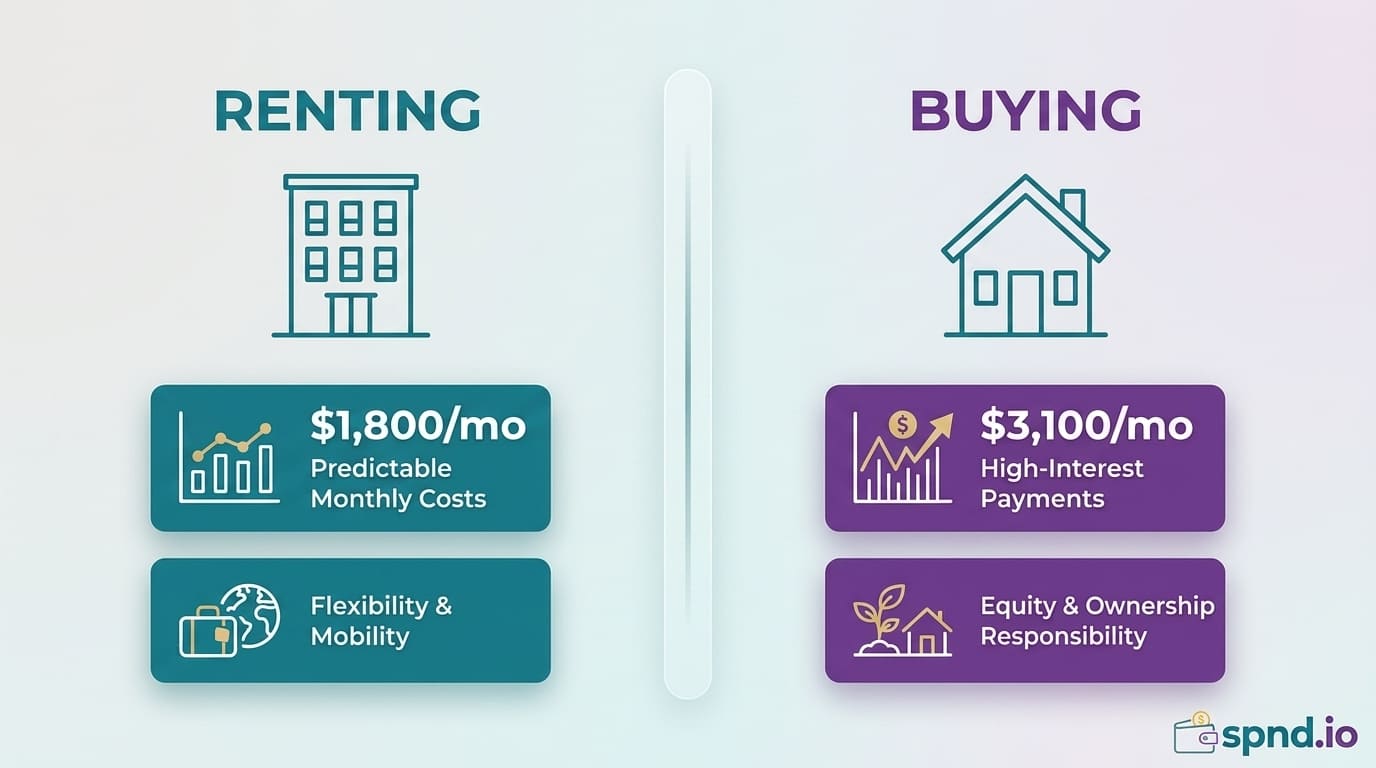
The 'renting is throwing money away' argument was always incomplete, and in 2026's market it is often plain wrong. Depending on your city, your timeline, and current interest rates, renting can be the financially smarter choice for years or even decades.
This guide walks through the actual buy-vs-rent math, the factors that matter most in today's market, and a framework for figuring out which one makes sense for your specific situation. Short version: the answer is neither universal nor obvious, and the numbers have shifted significantly since 2020.
The True Cost of Owning
When people compare 'rent vs mortgage,' they usually compare rent to the monthly principal and interest payment. This understates the cost of owning by 40-60%. The real monthly cost of ownership includes:
-
Principal and interest
-
Property taxes (1-2% of home value annually)
-
Homeowner's insurance ($1,000-$3,000/year)
-
Private Mortgage Insurance if down payment is under 20% (~$100-$400/month)
-
HOA or condo fees if applicable
-
Maintenance reserve (~1% of home value annually)
-
The opportunity cost of the down payment (what it could earn invested)
Example: $400,000 home, 20% down, 7% rate
-
Principal + interest: $2,130/month
-
Property tax (1.2% of value): $400/month
-
Insurance: $150/month
-
Maintenance reserve (1% of value): $335/month
-
Total true monthly cost: $3,015
Plus the $80,000 down payment that, invested at 7% instead, would earn about $5,600/year ($467/month) — pushing the all-in opportunity cost to about $3,480/month.
The True Cost of Renting
Renters have it simpler but also have costs people forget:
-
Monthly rent
-
Renter's insurance ($15-$30/month)
-
Annual rent increases (typically 3-5% in stable markets, more in hot markets)
-
No tax deduction equivalent to mortgage interest (US) — though the standard deduction usually offsets this
-
No equity building — but the down payment stays invested and growing
Rent vs mortgage: the fair comparison
A fair comparison puts renting a comparable unit next to the full cost of owning. If a comparable 3-bedroom rental costs $2,400/month, and the all-in cost of owning the $400,000 equivalent is $3,015/month plus the $467 opportunity cost, renting is actually $1,080/month cheaper than buying — a gap that favors renting as long as the down payment stays invested earning its expected return.
This reverses in markets where rent is higher relative to price. In cities where the same $400,000 home would rent for $3,200/month, buying pulls ahead.
The 5x Rule: A Quick Sanity Check
A common heuristic: if the home price is less than 15 times the annual rent on a comparable property, buying tends to win long-term. If it is more than 20 times the annual rent, renting tends to win. In between is the gray zone.
Price-to-rent examples
-
Home price $400,000, comparable rent $2,200/month ($26,400/year): ratio 15.2 — buying leans favorable
-
Home price $600,000, comparable rent $3,000/month ($36,000/year): ratio 16.7 — gray zone
-
Home price $1,200,000, comparable rent $3,800/month ($45,600/year): ratio 26.3 — renting strongly favorable
Many major coastal US cities and Toronto/Vancouver currently sit at price-to-rent ratios of 25-35, meaning renting is financially superior for most timelines. Mid-size cities in the interior (Pittsburgh, Kansas City, Edmonton, Winnipeg) often sit at 10-16, meaning buying is financially favorable.
Interest Rates Change Everything
At 3% mortgage rates (2020-21), buying won in almost every scenario. At 7-8% rates (2023-26), the break-even period gets much longer and the cost-of-ownership math tilts toward renting in many cases.
Same $400,000 home, different rates
-
3% rate: principal + interest ~$1,350/month
-
5% rate: ~$1,720/month
-
7% rate: ~$2,130/month
-
Difference between 3% and 7% on the same home: ~$780/month, or $9,400/year
Someone who bought at a 3% rate pays dramatically less for the same house than someone buying today. If you are evaluating buying in a high-rate environment, the math is simply different than it was for people who bought a few years ago.
The Time Horizon Question
Buying has significant upfront costs that you need time to recover. Transaction costs include:
-
Closing costs on purchase: 2-5% of home price
-
Closing costs on sale: ~5-6% including agent commissions
-
Moving costs, repairs, furnishing, etc.
On a $400,000 home, you could easily pay $40,000 in combined transaction costs across the buy-sell cycle. You need enough time in the home for appreciation and principal paydown to exceed those costs — otherwise you lose money buying.
Typical break-even periods in today's market
-
Stable market, reasonable rate, modest appreciation: 5-7 years
-
High-rate environment, flat prices: 8-12 years
-
Hot market with strong appreciation: 3-5 years
-
Declining market: buying may never break even
If you are not confident you will stay in the home for at least 5 years, renting is usually the safer financial choice. People who think they will stay but actually move within 2-3 years typically lose money overall on the transaction.
The Non-Financial Factors That Actually Matter
The buy vs rent debate often gets framed as purely financial. For most people, non-financial factors are bigger.
Reasons that favor owning
-
You want to renovate, paint, or modify freely
-
You want stability — no surprise rent increases or landlord decisions
-
You want to put down community roots
-
You value the specific home (not just the financial outcome)
-
You want forced savings — mortgage payments build equity whether you want them to or not
Reasons that favor renting
-
You value flexibility — job changes, relationship changes, life changes
-
You do not want to deal with maintenance, repairs, HOA politics, property taxes
-
You are not confident about staying in the area long-term
-
You prefer investing the down payment in diversified assets
-
You value the time and mental bandwidth that homeownership consumes
The Worst Reasons to Buy
-
'Renting is throwing money away.' Half-true at best. All housing costs money. The question is which total cost is lower, including the opportunity cost of the down payment.
-
'You'll get priced out forever if you don't buy now.' A fear-based pitch, often proven wrong. Markets cycle. People who panic-bought at peaks have historically been worse off than patient renters.
-
'A house is always a good investment.' Houses appreciate roughly in line with inflation over the long term in most markets, below stocks. The 'house as investment' narrative is heavily inflated.
-
'Your parents/friends/everyone else says to buy.' Their timing, market, rates, and life circumstances are not yours.
The Worst Reasons to Keep Renting
-
'I don't want to commit.' Fair, but after 5 years in the same city, the 'flexibility' argument gets thinner.
-
'Homeownership is too much work.' If you can't handle unclogging a drain, you are not ready for a house. But this is usually a skill gap, not a reason.
-
'Prices will crash.' Maybe. They might also rise. Waiting indefinitely for a specific market move is speculation, not strategy.
Breaking Down the Honest Decision
Five questions that sharpen the decision:
-
Will I definitely stay in this home for 5+ years? If no, rent.
-
What is the price-to-rent ratio for comparable homes? Under 15 favors buying, over 20 favors renting.
-
Can I afford the true cost of ownership (not just P&I) at under 28% of net pay? If no, I cannot afford to buy this house.
-
Do I have reserves after closing — 3-6 months emergency fund, plus $5-15K for repairs? If no, do not buy yet.
-
Is the non-financial value (stability, control, community) worth the potential financial cost of being wrong? For many people, yes — but name it honestly.
The Closing Frame
Buying a home is not automatically wise. Renting is not automatically wasteful. Both are legitimate financial strategies depending on the market, your timeline, and your priorities. In 2026's high-rate environment, the math favors renting in more scenarios than it did five years ago — especially in expensive coastal markets.
Run the numbers honestly, including all the costs, for your specific situation. Factor in how long you will realistically stay. Then make the choice that fits your life, not the choice that fits a decades-old slogan.
See the real numbers for your specific situation with the free Buy vs Rent Calculator on spnd.io. Enter the home price, your rent, expected stay, and current rates — the calculator shows your break-even point and total cost of each path.